
The Majesty Seal of Philip IV of France ("Philip the Fair")
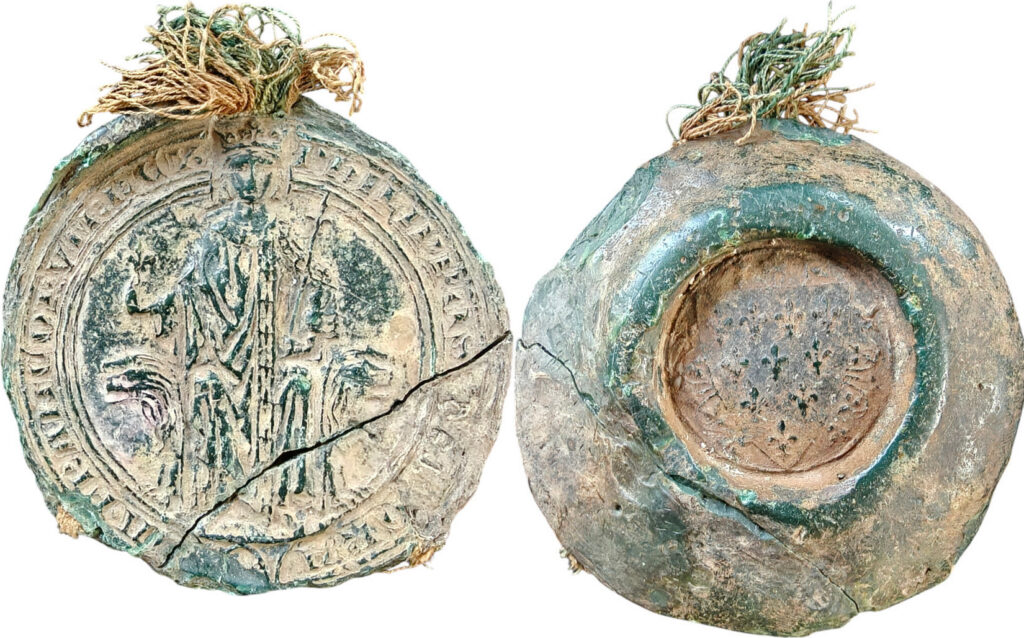
This is the great seal of majesty, in French the sceau de majesté, of Philip IV of France, known to history as Philip the Fair (Philippe le Bel). It was in use throughout his reign, from 1285 to 1314. In the records of the Sigilla database it is catalogued as seal-type number 2769, with its counter-seal registered separately as number 2770.
A seal is a mark in wax, produced by pressing an engraved metal matrix into a soft cake of wax attached to a document. In an age when few people could read and when a personal signature carried little legal weight, the seal was the instrument that authenticated an act. A charter without the king’s seal was simply parchment. With it, the document became an expression of royal will and was legally binding across the realm.
Iconography
The obverse presents the king “in majesty”, the formula that gives this class of seal its name. Philip is shown enthroned and crowned, facing the viewer in a rigid frontal pose. The throne is ornamented with lion heads, a motif that signals strength and justice and deliberately recalls the throne of Solomon described in the Old Testament, the biblical model of the wise and rightful ruler. In one hand the king holds a sceptre surmounted by a fleur de lys; in the other he holds a fleur de lys as well. The lily was the emblem of the French crown, and the composition as a whole communicates a single, carefully constructed message: the legitimate sovereign of France, seated, static and in full command.
The stillness of the figure is intentional. Majesty seals across medieval Europe avoid any sense of movement or action, because the image is meant to convey settled, permanent authority rather than a moment in time.
The legend
Around the circumference runs the inscription, known in sigillography as the legend. It reads:
PHILIPPVS DEI GRACIA FRANCORVM REX
Rendered in modern orthography this is Philippus Dei Gratia Francorum Rex, which translates as “Philip, by the grace of God, King of the Franks.”
Several features of the text deserve attention. In medieval Latin epigraphy the letter U is written as V, so PHILIPPVS reads simply as “Philippus”. The form Gracia is the medieval spelling of the classical Gratia, meaning “grace”. The phrase Dei Gratia, “by the grace of God”, is the heart of the legend. It advances a specific political claim, namely that royal authority derives directly from God rather than from the nobility or any earthly institution. The closing words, Francorum Rex, “King of the Franks”, identify the office. In a single formula the seal therefore states both the identity of the ruler and the divine source from which he claimed his power.
The counter-seal
The seal is double-sided. The reverse carries the counter-seal, a smaller design roughly four centimetres in diameter. It displays an escutcheon covered entirely with fleurs de lys, framed by a branch of ivy. This is the older French royal coat of arms, known as France ancien. Applying a distinct image to the reverse was a security measure: a seal impressed on both faces was considerably more difficult to counterfeit than one struck on a single side.
Material and dimensions
The seal is large, measuring approximately nine centimetres in diameter. It was executed in green wax and suspended from the document on plaited cords of green and yellow silk. The choice of colour was governed by chancery convention rather than aesthetics. Green wax was reserved for acts intended to remain valid in perpetuity, a practice established under an earlier king, Philip Augustus, whereas documents of temporary effect were sealed in yellow wax. A green-wax seal was thus a visual declaration that the decision it authenticated was meant to stand permanently.
Historical significance
Philip the Fair ranks among the most powerful and most controversial monarchs in French history. He strengthened and centralised the royal administration, entered into a prolonged and bitter conflict with the papacy, and in 1307 ordered the arrest of the Knights Templar and the suppression of their order. Each of these acts of government was recorded on parchment and given legal force by a seal of precisely this type. The object is therefore not merely a decorative curiosity but a working instrument of the medieval state, the point at which the will of the crown was converted into law more than seven centuries ago.
Record: Sigilla, base numérique des sceaux conservés en France (IRHT / CNRS), seal-type no. 2769, “Philippe IV de France, grand sceau, Roi de France, 1285/1314”, with counter-seal no. 2770.