
Great Seal with Counter-Seal of Philip II as Sovereign of the Netherlands, 1559–1580.
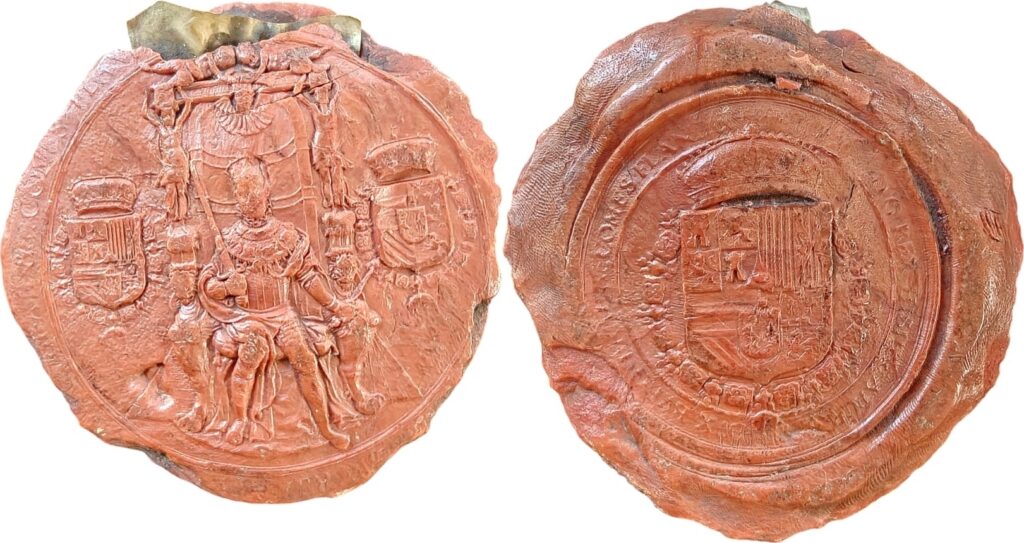
In October 1555 Philip II received the Netherlands from his father, Charles V, and in January 1556 Spain followed. This is the great seal with which his Privy Council sealed its letters, together with the matching counter-seal pressed into the back of the wax.
Material: red wax, double-sided pendant seal, with remains of the attachment at the top
Obverse: The ruler sits facing forward on a throne beneath a Renaissance canopy supported by two atlantes, with putti on the architrave. He wears full armour, the collar of the Order of the Golden Fleece around his shoulders, and the crown on his head. In his right hand he holds a raised sword. On either side of the throne is a crowned coat of arms.
On the left, the shield of his Spanish inheritance, quartered with Castile and León, Aragon and Aragon-Sicily, with Granada in base. On the right, the Habsburg-Burgundian shield with Austria, Burgundy modern, Burgundy ancient and Brabant, and over all an inescutcheon divided between Flanders and Tyrol. Two shields, two inheritances, and this seal belongs to the second.
Legend: PHILIPPVS D G REX HISPAN VTR SICIL &c ARCHID AVSTR DVX BVRG BRAB &c COMES FLANDRIAE &c
“Philip, by the grace of God King of the Spains and of both Sicilies, etc., Archduke of Austria, Duke of Burgundy and Brabant, etc., Count of Flanders, etc.”
Reverse (counter-seal)
The full crowned coat of arms, quartered with the arms of the Catholic Monarchs in 1 and 4 and the Habsburg-Burgundian quarters in 2 and 3, surrounded by the collar of the Golden Fleece with the fleece hanging below.
Legend: PHILIPPVS D G REX HISP &c ARCH AVST DVX BVRG BRAB &c COMES FLAND &c
“Philip, by the grace of God King of Spain, etc., Archduke of Austria, Duke of Burgundy and Brabant, etc., Count of Flanders, etc.”
The counter-seal is smaller than the obverse and was pressed into the back of the wax as an extra safeguard against forgery.
Dating
The title does the work. Through his marriage to Mary Tudor, Philip was also King of England from July 1554 until her death on 17 November 1558. In those years ANGL appeared in his title, including on the counter-seal of the seal he used at the time. Here we find only REX HISP. England has disappeared, so this seal dates from after November 1558.
There is also a limit at the other end. In 1580 Philip became King of Portugal, and from then on a small Portuguese escutcheon was added to the centre of his arms. That escutcheon does not appear on this example.
This type of seal therefore belongs to the period from 1559 to 1580.
One caveat: a seal matrix was not always altered as soon as a title changed, so it may sometimes have remained in use a little longer.
Documentation: Olivarius Vredius
This very seal is illustrated by Olivarius Vredius (Olivier de Wree, 1596–1652) in Sigilla Comitum Flandriae et inscriptiones diplomatum, Bruges 1639, p. 245. The obverse and counter-seal are engraved together there, with the same legends as on this example.
Above the engraving Vredius writes: “Habuit verò Philippus, obtentâ Portugalliâ, in Concilio suo Sanctiore, sigillum tale”. Below it: “Quo & ante eam obtentam fuit usus, sine parmula Lusitanica, quam idcirco, in adverso sigillo, omisi.”
In other words: after acquiring Portugal, Philip used such a seal in his Privy Council. He had already used it before that time, but without the small Portuguese shield, and for that reason Vredius left the shield out of the counter-seal. That is exactly the form of this example.
On p. 207 he shows the seal that preceded it, with the same throne and shields, but with REX HISP ANGL on the counter-seal. That was the seal of 1556–1558, when Philip was still King of England as well. The difference lies in that single word, ANGL.
Philip II
Born in 1527 in Valladolid, the son of Emperor Charles V and Isabella of Portugal, he died in 1598 at the Escorial. In 1554 he married Mary Tudor and became King of England alongside her. In 1555 he received the Netherlands, in 1556 Spain, and in 1580 Portugal.
He ruled from paper. Where his father travelled on horseback from imperial diet to battlefield, Philip sat at his writing desk and read everything himself, down to the notes in the margin. In the Netherlands, this went wrong. His church reforms, the persecution of Protestants and the taxes of the Duke of Alba led to the Revolt that began in 1568, and which he did not live to see end.
This seal dates from the years in which all of this happened. It hung from the letters of his Privy Council at the time when Alba came to the Netherlands and the Revolt broke out.
Available digitally via the Internet Archive: https://archive.org/details/bub_gb_CNSBZDBvNV4C/page/n260/mode/1up