
Majesty Seal of Emperor Sigismund of Luxembourg, 1433
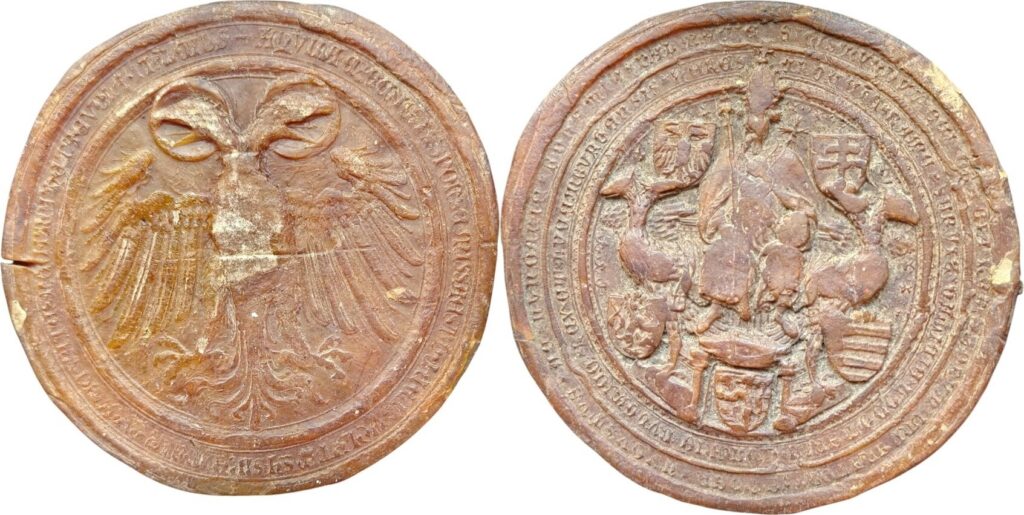
On 31 May 1433, Sigismund was crowned emperor in Rome by Pope Eugene IV. Shortly afterwards he had a new great seal engraved, the first on which he presents himself as emperor. This is that seal.
Obverse: The emperor sits facing forward on a Gothic throne, wearing the imperial crown, with the sceptre in one hand and the orb in the other. On either side of the throne is a double-headed eagle. Around the seat are five coats of arms, from left to right:
- the Holy Roman Empire, the double-headed eagle
- Hungary, the patriarchal double cross on a triple mount
- Bohemia, the crowned lion with a forked tail
- Árpád, the bars of the old Hungarian royal house
- Luxembourg, the crowned lion with a forked tail over bars
Legend:
SIGISMVNDVS DEI GRACIA ROMANORVM IMPERATOR SEMPER AVGVSTVS AC HVNGARIE BOHEMIE DALMACIE // CROACIE RAME SERVIE GALLICIE LODOMERIE COMANIE BVLGARIEQ REX ET LVCEMBVRGENSIS HERES
“Sigismund, by the grace of God Emperor of the Romans, ever august, and King of Hungary, Bohemia, Dalmatia, Croatia, Rama, Serbia, Galicia, Lodomeria, Cumania and Bulgaria, and heir of Luxembourg.”
Rama is medieval Bosnia; Lodomeria lies in present-day western Ukraine. The double stroke marks the point where the legend jumps from the outer ring to the inner ring. The same division can be seen on Sigismund’s golden bull of 1434 in the Klosterarchiv Einsiedeln.
Reverse (counter-seal)
A double-headed eagle with haloes.
Legend:
AQVILA EZECHIELIS SPONSE MISSA EST DE CELIS VOLAT IPSA SINE META QVO NEC VATES NEC PROPHETA EVOLAVIT ALTIVS
“The eagle of Ezekiel has been sent from heaven to the bride. She flies without limit, higher than any seer or prophet ever flew.”
The lines are taken from the sequence Verbum Dei, Deo natum, a hymn in honour of John the Evangelist, whose symbol is the eagle. Two of its verses have been joined into a single running sentence. Sigismund’s predecessors Henry VII, Louis IV and Charles IV still bore the motto Iuste iudicate filii hominum, “Judge justly, O sons of men”, on their counter-seals. As emperor, Sigismund replaced it with this verse and had the counter-seal enlarged to the same size as the obverse. His successor Frederick III later adopted the motto.
Who was Sigismund?
Sigismund was born in 1368, the son of Emperor Charles IV. In 1385 he married Mary of Hungary, and two years later he had himself crowned King of Hungary. This began a reign of fifty years, in which he lived through almost everything that century had to offer. In 1396 he suffered a crushing defeat against the Ottomans at Nicopolis on the Danube and escaped by boat. In 1408 he founded the Order of the Dragon. In 1410 he was elected King of the Romans.
His greatest achievement was the Council of Constance, which he himself had forced into being. There the Western Schism was ended, and after many years the Church once again had a single pope. But in that same city things also went badly wrong. Jan Hus had come to Constance under a safe-conduct from Sigismund, and in 1415 he was burned at the stake all the same. Bohemia never forgave him for it.
When his half-brother Wenceslas died in 1419, Sigismund was the rightful heir to the Bohemian crown. The Hussites, the followers of Jan Hus, refused to accept him as king. In 1420 he did have himself crowned in Prague Castle, but he could not hold the city. Together with the pope, he launched five crusades against the Hussites between 1420 and 1431. These were not expeditions to the Holy Land, but wars within Europe against Christians who were regarded as heretics. All five were broken on the Hussite armies. Only in 1436, after the Compacts of Jihlava, was he admitted to Prague and able to make his title a reality. He was 68 by then. Little more than a year later, on 9 December 1437, he died in Znojmo. In practice, he was truly King of Bohemia for barely a year.
The coats of arms tell that story too. He bore the arms of Bohemia as his family arms, as a son of Charles IV, even though for most of his life he could not rule the country itself. The Árpád bars came from his marriage to Mary, while he had no blood ties at all with the Anjou dynasty, who had borne these bars through Charles Martel. Both shields later passed to his grandson Ladislaus Posthumus.
With Sigismund, the House of Luxembourg died out in the male line. This seal dates from the final years of that house, made at the moment when he at last held everything he had ever striven for.