
Seal of Empress Maria Theresa for the Duchy of Brabant, after 1753.
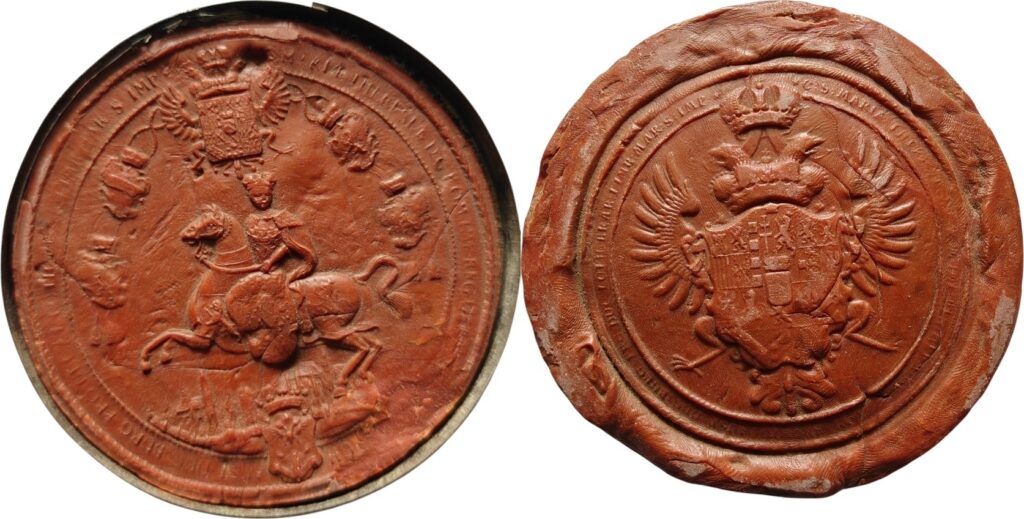
The great seal with counter-seal of Maria Theresa, used for documents that passed under the great seal of Brabant. In the literature this type is also described as the seal of the Council of Brabant.
The history behind it
When Emperor Charles VI died on 20 October 1740, his daughter Maria Theresa became sovereign of the Netherlands. With every change of ruler, the old seals had to be replaced. On 4 December 1741, Count von Harrach, lieutenant-governor and captain-general of the Netherlands, sent the design for the new seals to the fiscal office of Brabant. Quotations were requested from two engravers. François Harrewijn, engraver of Her Majesty’s seals, asked 840 guilders. Marcus Sax, an engraver from Berlin living in Brussels, offered to do the work for 735 guilders, excluding the silver. The Council of Finance decided that no more than 700 guilders was to be paid, and Sax received the commission. He was assisted by his partner Gusman Joachim. Not a single impression of this 1742 seal has been found to date.
The Peace of Aachen in 1748 ended the War of the Austrian Succession and returned the Netherlands to Maria Theresa, who had by then become empress. This imperial dignity once again meant new seals. On 10 July 1752, Governor Charles of Lorraine sent the model with the imperial attributes to the Council of Brabant. The price was set at 50 pistoles. The pistole was originally a Spanish gold coin (the doblón), and the sum came to 525 guilders in current silver money. The work was entrusted to the engraver Jacob Simon, who cut the seal in 1753.
Obverse
Maria Theresa on horseback, on a rearing steed, her head turned to face the viewer, her hair loose at the neck and her brow encircled by the imperial crown. She wears a richly flowered gown, a necklace of three rows of pearls and, over her shoulders, a heavy ermine-lined mantle fastened with an elegant clasp. The horse wears a caparison bearing the arms of Lothier, Brabant and Limburg.
Above the rider is the sovereign’s coat of arms for the Netherlands, placed on the double-headed eagle and surmounted by a royal crown, with the imperial crown above it, linked by two ribbons to both heads of the eagle. From the central shield, cords with tassels lead to four smaller coats of arms: on the left Lothier and Limburg, on the right Brabant and Limburg. At the bottom is a view of Brussels, on which the shield of the Margraviate of Antwerp is placed. The heraldic tinctures are indicated in the shields and on the caparison. The arms are set in Louis XV cartouches with shellwork and ducal coronets; only the shield of the Margraviate of the Holy Roman Empire bears a marquess’s coronet.
Legend, between two leafy borders, the wider one on the inside:
S : MARIÆ : THERESIÆ : D : G : ROM : IMP : REG : GERM : HVNG : BOH : ARCH : AVST : DVC : BVRG : PRO : DVCAT : LOTH : BRAB : LIMB : MAR : S : IMP :
Reverse (counter-seal)
The entire field is taken up by the coat of arms of the empress-queen, identical to that on the obverse, placed on the double-headed eagle and surmounted by a royal crown, with the imperial crown above the whole.
Legend:
C : S : MARIÆ : THERESIÆ : D : G : ROM : IMP : REG : GERM : HVNG : BOH : ARCHID : AVST : DVC : BVRG : PRO : DVC : LOTH : BRAB : LIMB : MAR : S : IMP :
The legend written out
Sigillum Mariae Theresiae, Dei Gratia Romanorum Imperatricis, Reginae Germaniae, Hungariae, Bohemiae, Archiducissae Austriae, Ducissae Burgundiae, pro Ducatibus Lotharingiae, Brabantiae, Limburgiae, Marchionissae Sacri Imperii.
“Seal of Maria Theresa, by the grace of God Empress of the Romans, Queen of Germany, Hungary and Bohemia, Archduchess of Austria, Duchess of Burgundy, for the duchies of Lothier, Brabant and Limburg, Margravine of the Holy Roman Empire.”
The C and S at the beginning of the counter-seal stand for contra sigillum. The legend of the counter-seal is otherwise the same as that of the great seal, with ARCHID instead of ARCH and the shortened form DVC instead of DVCAT.
The engraver
Jacob (Jacques) Simon, born in London and reputedly a grandson of the well-known engraver Thomas Simon. He settled in Brussels before 1746, the year in which his eldest son Mayer was born there. His second son, Jean-Henri, born in 1752, would later become known as a medallist. The edge of the great seal is inscribed: J. Simon, graveur de S.A.R. Sculpsit 1753. The edge of the counter-seal bears only J. Simon.
Rarity and preservation
On the death of a ruler it was customary to break the seal matrices, so that they could not be misused. The matrices of 1753 escaped this fate and are kept in the National Archives of Belgium in Brussels, in a copper case on four small feet, covered in green leather and decorated with two broad gilt copper bands, a lock and a gilt Louis XV handle. Inside is a wooden block in which the matrix was fixed. The silver plate of the great seal measures 12 centimetres in diameter, the counter-seal 98 millimetres.
Only a few impressions of the seal itself have survived. The finest known at the time of the 1947 publication hangs from a deed of 2 April 1778 in the charter collection of Brabant. Another example is kept in the archives of the Université catholique de Louvain. There it is dated 1760, with a diameter of 11.5 centimetres, and it hangs from a double parchment tag in a tin box.
Sources
Mariette Tourneur-Nicodème, “Les sceaux du Conseil de Brabant sous le règne de Marie-Thérèse”, Revue belge de Numismatique et de Sigillographie, vol. XCIII, Brussels 1947, pp. 117–124, with plates X and XI. The article is freely available on the website of the Royal Numismatic Society of Belgium: http://www.numisbel.be/1947_11.pdf
“Grand sceau de l’impératrice Marie-Thérèse d’Autriche, particulier pour le duché de Brabant”, 1760, Archives de l’Université catholique de Louvain, ark:/33176/dlo00004pK, https://archives.uclouvain.be/ark:/33176/dlo00004pK