
Seal of Emperor Alexander I of Russia, in a metal skippet, before 1825.
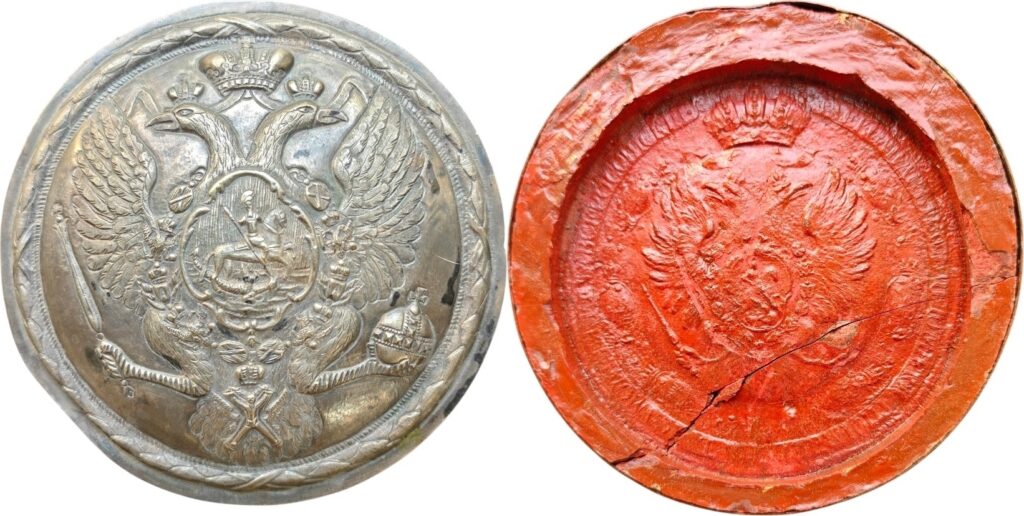
Not a coin and not a medal, but a pendant seal: a red sealing-wax impression that hung from cords at the bottom of a charter, kept in a small round metal box. Such a box is called a skippet or seal box, in Russian кустодия. It served purely as protection, because sealing wax breaks at the slightest knock. This type of seal belonged to the most important documents issued by the imperial chancery.
The skippet
A round box of two halves, made of embossed metal, through which the cords of the charter ran. The lid shows the double-headed eagle in relief, the same image as on the wax itself. The box stayed attached to the document and hung loosely beneath it, so that the wax could not strike against anything. That the wax is nevertheless cracked here is simply a sign of its age.
The seal
The double-headed eagle with outspread wings, beneath three crowns. The central crown floats above the two heads; the two smaller ones rest on the heads themselves. In its talons, the sceptre and orb. On its breast, a medallion with the arms of Moscow, the horseman piercing a dragon with his lance, surrounded by the collar of the Order of St Andrew. In Russian this rider is called the ездец. Until the 18th century he was seen as the ruler himself; only under Peter the Great was he officially named St George. Around the edge runs a braided laurel wreath.
Note also the direction of the rider. Looking at the wax, he rides to the right. That is how he appeared in the Russian arms for centuries. In 1856–1857, under Alexander II, Baron Bernhard von Köhne revised the imperial arms and turned the rider around, so that from then on he rode to the left. This followed Western European rules, but went against Russian tradition. This too places the seal before that reform, and therefore not under Alexander II.
Around the eagle are six small shields, the six titular arms of the empire. Three tsardoms and three grand principalities:
- Kazan, the crowned winged dragon Zilant
- Astrakhan, a crown above a curved sabre
- Siberia, two sables together supporting a crown and two bows
- Kiev, the Archangel Michael
- Vladimir, the crowned lion with a sword
- Novgorod, two bears beside a throne with crossed staffs
Legend:
АЛЕКСАНДРЪ Б.М. ИМПЕРАТОРЪ И САМОДЕРЖЕЦЪ ВСЕРОССIЙСКIЙ
“Alexander, by the grace of God Emperor and Autocrat of All Russia.”
The legend runs clockwise, starting at the heads of the eagle, where the emperor’s name stood. АНДР can still be read there, and further on the final word ВСЕРОССIЙСКIЙ stands out clearly in the wax. The abbreviation Б.М. stands for Божiею Милостiю, “by the grace of God”.
It is precisely these six shields that date the piece. It was Peter the Great who had the arms of the most important titular territories placed on the wings of the eagle, initially Kiev, Vladimir and Novgorod together with the tsardoms of Kazan, Astrakhan and Siberia, a custom borrowed from Western European heraldry. In 1832 Nicholas I revised the state arms again: still six shields, but now five tsardoms and one grand duchy, as Kiev, Vladimir and Novgorod made way for the Kingdom of Poland, the Tsardom of Tauric Chersonesus (the Crimea) and the Grand Duchy of Finland. In 1857, under Alexander II, the number rose to eight. A seal showing Kiev, Vladimir and Novgorod therefore belongs to the period before 1832.
What it was used for
Seals in metal skippets were used by the Ministry of Foreign Affairs: state acts, treaties and documents entrusted to diplomats. They also hung from the emperor’s letters of grace, such as patents of nobility, grants of estates and grants of arms. Not an everyday office seal, then, but the mark of a personal decision by the emperor.
Who was Alexander I?
Born in 1777 in St Petersburg, he was brought up by his grandmother Catherine the Great, who would rather have seen him on the throne than his father. In March 1801 his father, Paul I, was murdered in St Michael’s Castle by a group of officers. Alexander knew of the plot and carried that knowledge with him for the rest of his life.
His reign was dominated by Napoleon: defeat at Austerlitz in 1805, the Peace of Tilsit in 1807, and in 1812 the French invasion, in which Moscow went up in flames and the Grande Armée melted away on its retreat. In 1814 Alexander himself rode into Paris. At the Congress of Vienna he was one of the men who redrew the map of Europe, and afterwards he founded the Holy Alliance.
In his later years he became religious and withdrawn, leaving government largely to others. He died in 1825 in Taganrog on the Sea of Azov, far from the capital. That distant deathbed kept alive for a long time the story in Russia that he had not died at all, but lived on in Siberia as the hermit Fyodor Kuzmich.
The shields on this seal tell part of that story. Finland had joined the empire in 1809 and the Kingdom of Poland in 1815, and Alexander bore both titles. Yet their arms do not yet appear on the seal. They were given a place on the eagle’s wings only under his successor.
Literature
Remarkably little has been published on seals in metal skippets. The subject belongs more to phaleristics than to heraldry, and has therefore fallen between two fields. What does exist:
Е.И. Каменцева, Н.В. Устюгов, Русская сфрагистика и геральдика, Москва, Высшая школа, 1974, глава VI “Печати и гербы Российской империи”, с. 173–203. The standard work on Russian sigillography. The full text of that chapter is available online, with illustrations of several of these seals:
http://ogeraldike.ru/books/item/f00/s00/z0000005/st007.shtml
Gerboved
Е.В. Пчелов, “Вокруг двуглавого орла”, Историк, № 6, 2015, с. 47–51. On the titular arms on the eagle’s wings and the changes of 1832 and 1857:
https://xn--h1aagokeh.xn--p1ai/journal/post/5244
www.academia.edu/30507740
Eugene Pchelov (Евгений Пчелов)
Google Sites: история таганрогского герба