
Majesty Seal of Emperor Charles IV, 1355
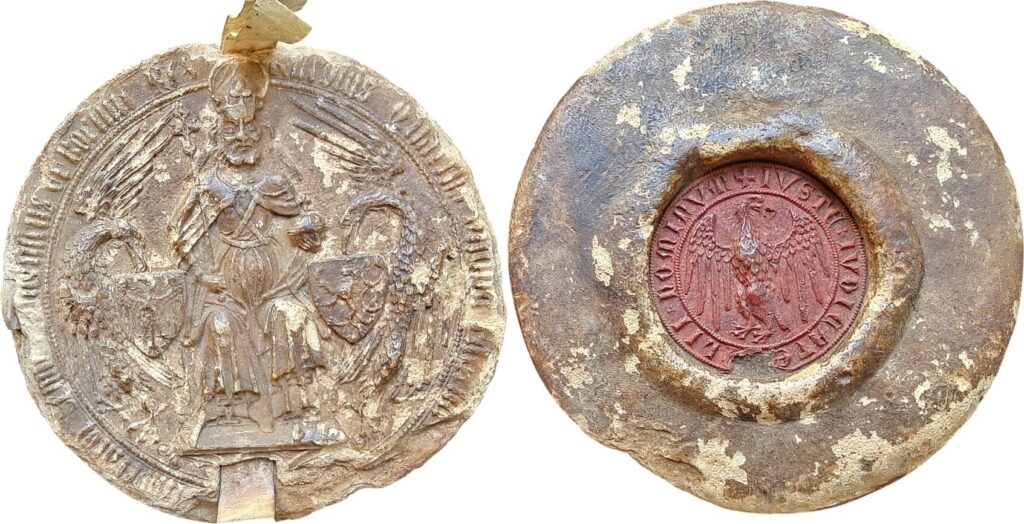
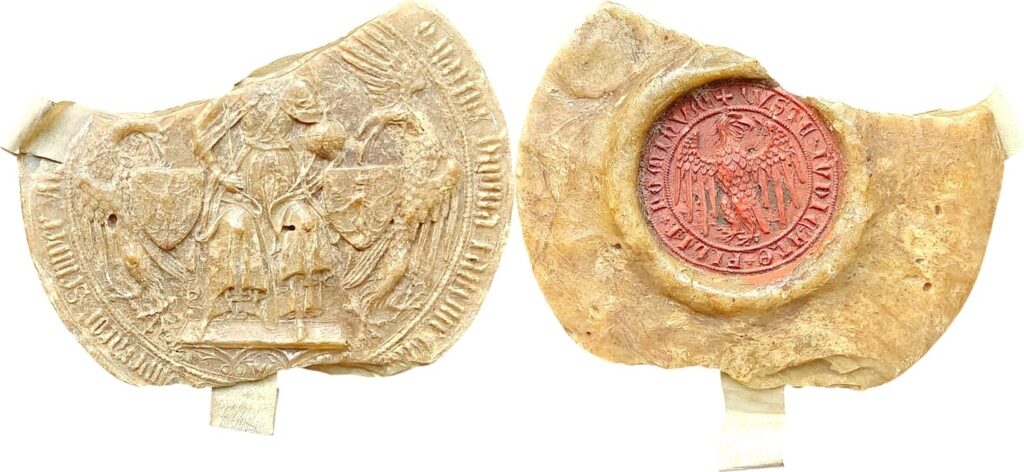
Seals like this example were made of beeswax and attached to the most important charters. For the most solemn documents of all, Charles IV also used a golden bull.
Obverse: the emperor seated on his throne, with crown, sceptre and orb. The crown has three fleurons and a single arch, and is worn over a mitre. On either side of the throne is a coat of arms, held by eagles: on the right the arms of the House of Luxembourg-Bohemia, on the left those of the Holy Roman Empire.
Legend: KAROLVS QVARTVS DIVINA FAVENTE CLEMENCIA ROMANORVM IMPERATOR SEMPER AVGVSTVS ET BOEMIE REX
Translation: Charles the Fourth, by the favour of divine mercy, Emperor of the Romans, ever august, and King of Bohemia.
Reverse: a secretum, also known as a contrasigillum or counter-seal, showing an eagle. This smaller seal was pressed into the back of the wax and served as an extra safeguard against forgery.
Legend: + IVSTe + IVDICATe + FILII + hOmInVm
Translation: Judge justly, O sons of men. The phrase comes from Psalm 57, verse 2 in the Vulgate, and was a deliberate choice for a ruler who saw himself as the judge of the Empire.
Comparable example: Archive of the Bohemian Crown, National Archives, Prague (NA, AČK), inv. no. 475.
Charles IV
Born in May 1316 in Prague and originally named Wenceslas, he died in 1378. From 1346 he was King of the Romans and King of Bohemia, and from 1355 Emperor of the Holy Roman Empire. At the age of seven he was sent to the French court to be educated, and this shows in the way he later ruled.
He was one of the most learned and diplomatically skilful rulers of his age. Where others waged war, he bought, married and inherited his way to power. Under his reign, Prague became the political, economic and cultural heart of the Holy Roman Empire, and eventually its capital.
In 1354 Charles crossed into Italy with an armed retinue to secure recognition for the authority of the House of Luxembourg and its Bohemian possessions. In early January 1355 he received the Iron Crown of Lombardy in Milan, and at Easter, on 5 April 1355, the imperial crown in Rome from the hands of the papal legate. This seal belongs to that new title.
At the height of his reign, the Holy Roman Empire stretched across Central Europe and into part of Southern Europe.